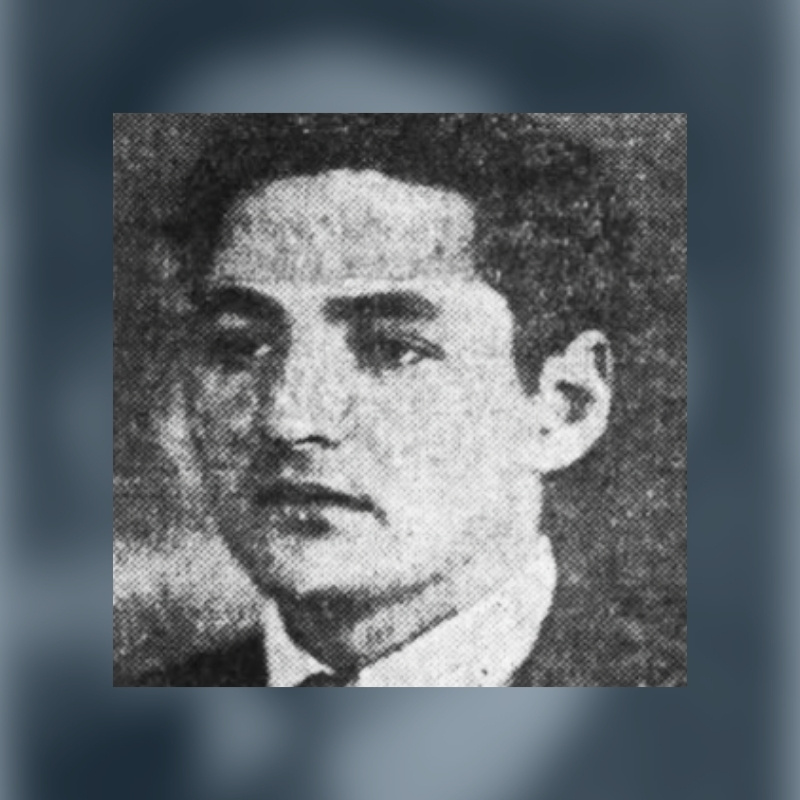
On a quiet Saturday night in 1931, a 19-year-old cattle dealer sat at his desk to write a check that he never got the chance to finish signing.
Investigators were left with more questions than answers – a missing revolver, a name on a check no one could trace, and a household already tangled in rumor and tension. What followed was a shifting investigation, a contested admission, and a trial that forced a small New England city to confront issues of race, reputation, and reasonable doubt.
September 26, 1931
It was just after 11 p.m. on Saturday night, September 26th, 1931 when 38-year-old Eleanor Johnson pulled up to the Levine family cattle farm on the Sidney Road in Waterville, Maine with her neighbor, Herbert Hart.
According to reporting by the Portland Press Herald, Eleanor worked as housekeeper and household manager for the Levine family, who operated a successful cattle dealing business from the property. Herbert himself was a tailor, so before he dropped Eleanor off and headed two houses down to his own home, Eleanor asked him to come inside for a minute. She had a dress and coat that needed repairing and wanted to hand them off before the night was over.
As she walked down the hallway toward the bedrooms, she was stopped in her tracks. She screamed and called for Herbert to come quickly. There was a person laying lifeless on the floor.
At first, neither of them were sure who the person was. Eleanor asked if it was Abie – short for Abraham, one of the Levine brothers – but he couldn’t be sure. Eleanor asked what she should do. Herbert told her to call the police.
At 11:20 p.m. Eleanor phoned police headquarters. She told them there was an accident about two miles down the Sidney Road and then she hung up.
That report of an accident created confusion for responding officers. The Waterville Police Chief, the Captain, and another officer drove several miles down the Sidney Road that night searching for a crash scene. When they found nothing, they turned back toward headquarters.
With no police in sight and panic mounting, Eleanor and Herbert got back into Herbert’s car and drove into the city themselves to find 22-year-old Merton Levine, another of the Levine brothers. They notified police again, this time with clearer details about what they had found at the farmhouse.
Merton, Eleanor and Herbert arrived at the house before police did. Merton turned the body over to discover the lifeless person was in fact his younger brother, 19-year old Abraham Levine.
Abraham had been face-down near his roll-top desk, a pen still clutched in his hand. He was the victim of multiple gunshot wounds.
Medical Examiner Dr. John G. Towne removed four bullets from Abraham’s body during the autopsy. He suffered two shots to the head, one behind the left ear, and two to the body, one of them mere inches from his heart. All four shots were fired at extremely close range. There were powder burns on his skin and singed hair at the entry sites on his head.
Authorities believed the murder weapon to be a .32 caliber revolver, but whoever shot Abraham took the firearm with them. It wasn’t anywhere at the scene.
There were no clear signs of a struggle in the room around Abraham. On the desk, police found a check made out for ten dollars to a “Leland Gray.” Abraham’s signature was unfinished, trailing off after “A-B-R-A-H-A,” with the pen line dragging sharply across the page before he could sign the letter M. In the memo line, someone had written: “For Mrs. Johnson’s cash.” The corresponding stub for that check was nowhere to be found.
Robbery was quickly dismissed as a motive. A lot of cash and some other checks were still on Abraham’s person.
A young man, seated at his desk, mid-signature, shot four times at close range with no struggle, no weapon, and a name on a check that no one could immediately identify…Investigators had a tall task in front of them. But before the Levine home became a crime scene, it was the center of a working farm, a family business, and a household with complicated dynamics long before a single shot was fired.
The Levine Family & Eleanor
The Levine family was well-known in the Waterville area for its cattle dealing business.
According to reporting by the Sun-Journal, at the time Abraham was shot, their mother was a patient at the Augusta State Hospital and the Levine patriarch, Lewis Levine, was out of state. He had reportedly traveled to Nevada seeking a divorce – a type of divorce not permitted under Maine law at the time. He’d been gone for at least six weeks, leaving Abraham in charge of the farm and the business.
Abraham handled the bookkeeping, the accounts, and the day-to-day management of livestock transactions, but he wasn’t the only person left in charge while his father was away. Managing much of the other essential logistics of the Levine family life was Eleanor Johnson.
Eleanor had worked at the Levine home and farm for about two years before the murder. Her life in Maine, however, began long before that job.
She was born in Maryland, later moved to Philadelphia, and attended school for four years before financial necessity forced her to leave and begin working to support her family. Eleanor told the Morning Sentinel that in 1913, she came to Maine to work as a housekeeper for a family in Waterville, where she remained until 1916. After that, she took another farm position in town, then moved to Oakland, Maine, where she worked for thirteen years until the patriarch of that household passed away.
From there, she moved between positions and even left the state for a time with a Maine family, returning a few months later. It was after that return that she met Lewis Levine, who offered her the position at his farm.
Eleanor initially declined the job. After touring the property and seeing the size of the house and barns, she believed the workload would be overwhelming for one person, but Lewis assured her he would make it manageable. They negotiated a wage of $12 per week, and she began work there in July of 1929.
Despite Lewis’s promises, the job quickly became far more than housekeeping. She was responsible for hiring farmhands, overseeing renovations and repairs to buildings, handling shopping and cooking, and directing household operations in the absence of the men who were often away for long periods of time.
Eleanor recalled that Lewis Levine told her he wanted her to feel like part of the family. If the boys went to the movies – a picture show, as it would have been called – they took her with them. If they went for ice cream, she went, too. Eleanor said that Lewis told her he didn’t want her to feel beneath them because she was a Black woman.
But that dynamic didn’t last. She later said that people in town began whispering about her relationships with members of the Levine family. Some people made comments directly, expressing judgment about a Black woman working so closely with a Jewish family and spending time with a young Jewish man, appearing with them in public. Over time, members of the Levine family became less willing to be seen with her out and about in town.
Eleanor’s Story
The morning after Abraham was found dead, Eleanor was brought in by police and questioned for several hours. Her account of that Saturday night was detailed and, at least on paper, fairly clean.
She said she had dinner at the farm that evening with Abraham, his brother 16-year-old Samuel Levine, and a farmhand. She told police that around 7:45 p.m. Abraham left the house after being picked up by someone. She claimed that was the last time she saw him alive.)
Eleanor explained that she called a cab around 8 p.m. and went into town to see a movie at the Haines Theater. Now, the cab driver remembered the call being closer to 9 p.m., but the movie ticket stub placed her at or near the theater around 8:15 p.m. so it’s possible the cab driver was mistaken. And plus, Eleanor could describe scenes from the film and theater attendants remembered seeing her.
After the movie, she said she went to find Merton Levine at the local dance hall to ask for a ride home but he wasn’t ready to leave. He told her to ask their neighbor, Herbert Hart, instead. Eleanor said she found Herbert at a shop down the street and the two left together about thirty minutes later. They arrived at the farm together and that’s when they found Abraham.
At that stage, police considered it a solid alibi and so she was released. Still, Eleanor retained an attorney.
This story continues on Dark Downeast. Press play to hear the full episode wherever you get your podcasts.
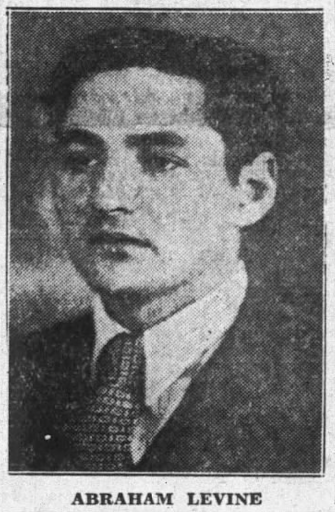
Abraham Levine. Source: Kennebec Journal
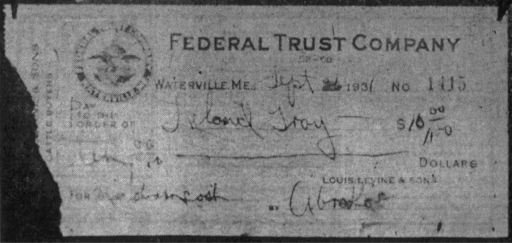
Unfinished check found on Abraham’s desk. Source: Portland Press Herald
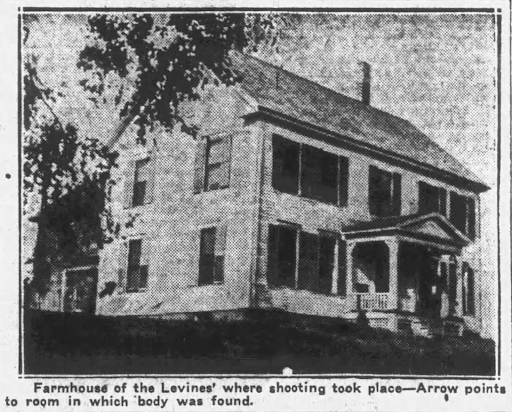
The Levine Home in Waterville, Maine. Source: The Lewiston Daily Sun
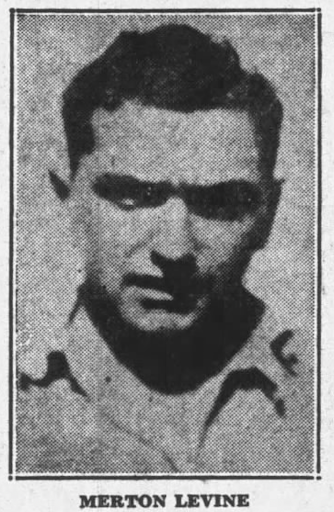
Merton Levine. Source: Kennebec Journal
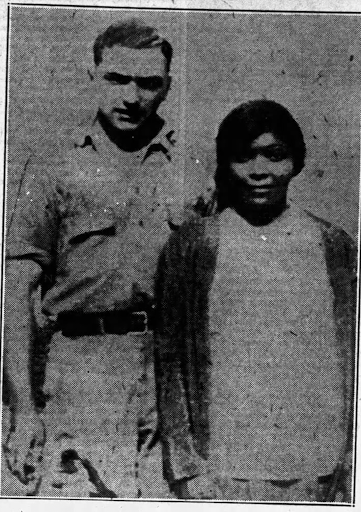
Merton Levine and Eleanor Johnson. Source: Morning Sentinel
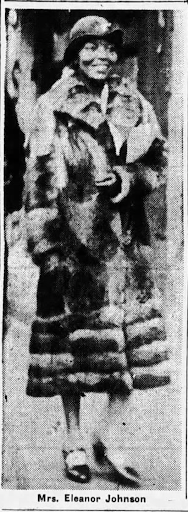
Eleanor Johnson. Source: Sun-Journal
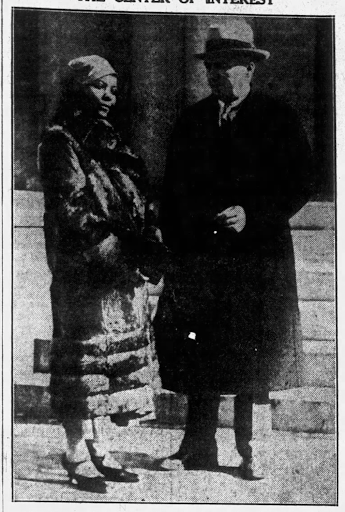
Eleanor Johnson with her attorney James L. Boyle. Source: Morning Sentinel
Episode Source Material
- Levine, 19, is slain at home near Waterville, Lewiston Daily Sun, 28 Sep 1931
- Revenge attributed as motive for slaying Abraham Levine, Portland Press Herald, 28 Sep 1931
- Revenge seen in slaying of Sidney cattle dealer, Kennebec Journal, 28 Sep 1931
- No stranger killed Abraham Levine, Sun-Journal, 28 Sep 1931
- Fairfield youth shot to death, Associated Press via Bangor Daily news, 28 Sep 1931
- Charge housekeeper of slain Levine once threatened his life, Associated Press via Kennebec Journal, 29 Sep 1931
- […] housekeeper freed in Levine murder, Associated Press via Biddeford-Saco Journal, 29 Sep 1931
- Authorities seek clews to slayer of Fairfield man, Associated Press via Bangor Daily News, 29 Sep 1931
- Father says Levine slain by housekeeper, Associated Press via Lewiston Daily Sun, 29 Sep 1931
- Levine’s brother and father assert […] threatened boys’ life, Portland Press Herald, 29 Sep 1931
- Waterville murder victim is interred, Evening Express, 29 Sep 1931
- Stories of wild parties at Levine Farm at which Abraham assisted are investigated by local officers, Morning Sentinel, 30 Sep 1931
- Marden to turn to Merton Levine for more details, Portland Press Herald, 30 Sep 1931
- Vain search for pistol in Levine death, Associated Press via Kennebec Journal, 30 Sep 1931
- Stomach analysis may prove of little value as to Levine’s death, Sun-Journal, 1 Oct 1931
- Cartridge located in Mrs. Johnson’s box of magazines, Portland Press Herald, 1 Oct 1931
- ‘Leland Gray’ fiction, murder probe hints, Evening Express, 1 Oct 1931
- Mrs. Johnson denies knowledge of cartridge found among her magazines in attic Levine home, Morning Sentinel, 1 Oct 1931
- Cartridge is new clue in Levine case, Associated Press via Kennebec Journal, 1 Oct 1931
- ‘Whoopee’ parties at Levines Farm are probed by officials, Morning Sentinel, 2 Oct 1931
- Levine alive at 7:30 on night he was slain, Associated Press via Lewiston Daily Sun, 2 Oct 1931
- Little new develops in Levine murder, Portland Press Herald, 2 Oct 1931
- Three revolvers definitely placed on Levin farm, Portland Press Herald, 3 Oct 1931
- Father promised jewelry and automobile Mrs. Johnson says as she relates story of life, Morning Sentinel, 3 Oct 1931
- Levine shot three hours after supper is Andrews’ report, Associated Press via Lewiston Daily Sun, 5 Oct 1931
- Grand Jury may hear evidence in Levine case, Sun-Journal, 6 Oct 1931
- Guay will aid officers, Morning Sentinel, 6 Oct 1931
- Mystery letter warns brother of slain youth, Evening Express, 7 Oct 1931
- Merton Levine is threatened, Morning Sentinel, 7 Oct 1931
- Merton Levine is questioned about his slain brother, Portland Press Herald, 8 Oct 1931
- Merton Levine is grilled by police seeking new angles in murder case, Morning Sentinel, 8 Oct 1931
- Await report of Shephard on bullets, Morning Sentinel, 15 Oct 1931
- Police convinced two handwritings on Levine’s check, Portland Press Herald, 16 Oct 1931
- Pal of murdered man gets note saying “you’re next”, Evening Express, 17 Oct 1931
- Waterville golf pro told in note “you are next”, Portland Press Herald, 18 Oct 1931
- Exhume body of dog on Levine farm; seek bullets, Morning Sentinel, 20 Oct 1931
- Waterville police succeeded in exhuming dog, The Times Record, 22 Oct 1931
- Claim is made that Levine family seeks Skowhegan sheriff in murder case, Morning Sentinel, 24 Oct 1931
- Gun used to kill dog on Levine farm traced by police to Philadelphia, Morning Sentinel, 26 Oct 1931
- Handwriting slant on Levine murder, Sun-Journal, 27 Oct 1931
- Expect developments soon in Levine murder mystery, Sun-Journal, 28 Oct 1931
- Levine murder bullets are taken to Boston, Portland Press Herald, 28 Oct 1931
- 2 handwritings on Levine check word of expert, Associated Press via Kennebec Journal, 29 Oct 1931
- Bullets clue in Levine death, Biddeford-Saco Journal, 29 Oct 1931
- Merton Levine faces auto driving charge, Evening Express, 14 Nov 1931
- Discover new clue in death Waterville man, Associated Press via The Commercial, 1 Dec 1931
- Believe Levine death gun found in Waterville dump, Evening Express, 1 Dec 1931
- Revolver believed to have been used in Abraham Levine death found in Gilman Street dump, Morning Sentinel, 2 Dec 1931
- Revolver’s age blocks inquiry in Levine case, Evening Express, 3 Dec 1931
- 2 charged with Levine killing, Evening Express, 11 Dec 1931
- Portland officers assist local police in arresting two […] at Bath, Morning Sentinel, 11 Dec 1931
- Housekeeper under arrest in Waterville–Fatal gun traced to Portland, Associated Press via Biddeford-Saco Journal, 11 Dec 1931
- Charge Levine slays brother, Associated Press via 11 Dec 1931
- Housekeeper says Merton admits deed, Sun-Journal, 11 Dec 1931
- Merton Levine, Mrs. Johnson are arraigned, Evening Expressed, 12 Dec 1931
- Murder charge against Levine and Mrs. Johnson, Associated Press via Kennebec Journal, 12 Dec 1931
- Mrs. Johnson relates story of Levine slaying, Biddeford-Saco Journal, 12 Dec 1931
- Threats against wife of former Levine farmhand, Associated Press via Lewiston Daily Sun, 14 Dec 1931
- Mrs. Johnson pleads not guilty, in both cases against her, Sun-Journal, 14 Dec 1931
- Wire to Merton Levine was from Farmington; question H.G. Clifford, Associated Press via Sun-Journal, 15 Dec 1931
- Levine hearing opens in Waterville court, Evening Express, 22 Dec 1931
- Merton’s attorneys to wage fight for freedom today, Morning Sentinel, 22 Dec 1931
- Merton Levine claims frame-up when police grilling Mrs. Johnson, Sun-Journal, 23 Dec 1931
- State’s witnesses in murder hearing are grilled by Merrill, Morning Sentinel, 23 Dec 1931
- The Detailed Testimony, Morning Sentinel, 23 Dec 1931
- Levine and [Johnson] held for Grand Jury on charge of murder, Associated Press via Lewiston Daily Sun, 14 Dec 1931
- Mrs. Johnson indicted but not Levine, Sun-Journal, 5 Feb 1932
- Grand Jury indicts Mrs. Johnson; frees brother of victim, The Commercial, 6 Feb 1932
- Indict Mrs. Johnson for murder, Kennebec Journal, 6 Feb 1932
- Accused […] calms jail’s unruly with her spirituals, Evening Express, 12 Feb 1932
- Levine murder trial postponed to next Tuesday, Sun-Journal, 17 Feb 1932
- Jury quickly chosen to try Mrs. Johnson, Evening Express, 23 Feb 1931
- Trial of Mrs. Johnson for Levine murder opens today, Morning Sentinel, 23 Feb 1932
- 7 state witnesses testify at trial of Mrs. Johnson for Levine murder, Portland Press Herald, 24 Feb 1932
- Medical, police experts testify in Levine killing, Evening Express, 24 Feb 1932
- Witnesses tell of finding body, Morning Sentinel, 24 Feb 1932
- Place […] near dump where revolver was thrown by slayer, Kennebec Journal, 25 Feb 1932
- Defense in Johnson trial opens, Associated Press via The Commercial, 26 Feb 1932
- Mrs. Johnson at show night Levine killed, Sun-Journal, 26 Feb 1932
- Mrs. Eleanor Johnson denies threatening to kill Abraham Levine, Portland Press Herald, 27 Feb 1932
- Tells of nurse role held in Levine home as she denies guilt, Kennebec Journal, 27 Feb 1932
- Merton Levine tells his story at murder trial, Evening Express, 27 Feb 1932
- Jury finds Mrs. Johnson not guilty of slaying Abraham Levine at Waterville, Portland Press Herald, 28 Feb 1932
- Wild demonstration of joy as Mrs. Johnson is acquitted of slaying, Kennebec Journal, 29 Feb 1932
- Mrs. Johnson “not guilty” of murder; jury out 3 ¼ hours, The Lewiston Sun, 29 Feb 1932
- Jury frees Mrs. Johnson on charge of murdering Abraham Levine in long evening session by E.D. Talberth, Morning Sentinel, 29 Feb 1932
- Mrs. Johnson not to leave Waterville, Associated Press via Lewiston Daily Sun, 1 Mar 1932
- The Johnson Case, Morning Sentinel, 2 Mar 1932
- Sues Portland Maine Publishing Co. for $20,000 damages, Kennebec Journal, 4 Apr 1932
- Settle $20,000 libel suit out of court, Sun-Journal, 17 Jun 1932
- Mrs. Eleanor Johnson has no record here, Portland Press Herald, 17 Jun 1932
- Investigators still active in Levine case at Waterville, Evening Express, 26 Sep 1932
- Condition of Levine is reported “good”, Evening Express, 26 Jul 1934
- Second unsolved murder in Waterville in recent years, Morning Sentinel, 6 May 1936
- Six murders in city since 1802; only one is unsolved, Morning Sentinel, 4 Jan 1939
- City Notice, Morning Sentinel, 28 Feb 1972
- Informal hearing held on proposed apartment units by John Bacheller, Morning Sentinel, 3 Mar 1977
- Woman visits her attorney 45 years after murder trial by Gene Letourneau, Kennebec Journal, 2 Dec 1977
- ‘If I had been a white woman…’ by Gene L. Letourneau, Morning Sentinel, 2 Dec 1977
- Rumrunners, murder clipped for posterity by Gerry Boyle, Morning Sentinel, 22 Mar 1986
- Skowhegan’s oldest resident presented Boston Post cane by Darla L. Pickett, Morning Sentinel, 26 Jun 2003
- Maine State Legislature Report of the Attorney General for calendar years 1931-1932
- Charlie Robinson Obituary, The Reporter Dispatch, 2 Nov 1967
- Merton M. Levine Obituary, Morning Sentinel, 28 Jul 1997
- Emmons J. Young Obituary, Morning Sentinel, 8 Dec 2001
- Eleanor Johnson Robinson Obituary, Morning Sentinel, 19 Nov 2004