In April of 1976, an anonymous call to a sheriff’s department in Maine alerted investigators to something almost impossible to imagine: a burning station wagon hidden off a remote road, and what looked like a body inside. What they found would open a case filled with contradictions.
The victim was James Cassidy, a Massachusetts bank vice president, father of three, churchgoing family man, and by all accounts someone living a quiet, ordinary life. But in the days before his death, Jim had vanished across state lines, federal authorities were preparing to arrest him on embezzlement charges, and whispers of missing money, valuable stamps, and possible organized crime connections began to surface.
Nearly fifty years later, his death remains unsolved.
If you have any information about this case, please contact the Maine State Police, Major Crimes Unit – North at (207) 973-3750, or use their toll-free line at 1-800-432-7381. You can also submit information anonymously by using the tip form.
Anonymous Call
In the early spring of 1976, the woods of eastern Maine were still quiet from winter. Snow had mostly melted, but the ground was soft, the trees bare, and the long stretches of road that cut through the forests between Bangor and the coast were often empty for miles at a time.
According to reporting by the Bangor Daily News, on the morning of April 7th, that quiet was broken by a phone ringing at the Penobscot County Sheriff’s Department. At 9:01 a.m., an unidentified man on the other end of the line told the dispatcher that he was heading out to go fishing “out beyond Parks Pond” when he came across a disturbing sight along the side of the road: There was a gutted-out station wagon on fire and it looked like there was a human body in the back of the vehicle, he said.
The dispatcher tried to confirm what the caller had seen, where exactly it was located, and who he was but before the conversation could go much further, the line went dead. The man hung up without identifying himself.
Even with so little information and the anonymous nature, the call didn’t feel like a prank. It was specific and concerning enough that the Sheriff’s Department acted on it.
Deputies began searching the area described in the call, focusing on Route 9 and Route 180 on either side of Parks Pond in and around Clifton, Maine. They extended their search as far as Otis about seven miles away, scanning the roadside for any sign of a vehicle fire – smoke, burned wreckage, anything that might match the caller’s description.
After a full day of searching, they found nothing. Route 9, which is often called “The Airline”, was the only major road cutting through that stretch of rural eastern Maine, but the region was also laced with unnamed trails and tote roads, narrow logging routes that cut deep into the woods and were easy to miss from the main road. Though their search was unsuccessful, the Sheriff’s Department still believed there might be something out there, so they made a public appeal.
Through the media, investigators asked the anonymous caller to contact them again and provide more specific directions so they could locate the car and the body he claimed was inside it. The request appeared in the Bangor Daily News on April 8th, and it was broadcast on local radio stations as well.
Later that same day, the phone rang again at the Sheriff’s Department. The anonymous man called back.
He was still unwilling to identify himself. But this time, the caller gave investigators information they had been missing. According to reporting in the Ellsworth American, the man told the Penobscot County Sheriff’s Department that the burned station wagon was located about 600 feet from a discontinued section of Route 9 near DeBec Pond, just over the Hancock County line.
Because of the location, the investigation was turned over to the Hancock County Sheriff’s Department, but the circumstances surrounding the discovery quickly drew in the Maine State Police as well.
With those new details from the anonymous caller, investigators were finally able to find the scene. Hidden off the roadway was the wreckage of a 1971 Chrysler station wagon, burned and gutted by fire.
Inside the vehicle, investigators confirmed the grim scene that the caller had described. There was a human body in the car. According to reporting by Jeff Strout in the Bangor Daily News, the remains were found in the front seat – not the back as the caller had said.
The registration for the station wagon indicated the owner was 43-year-old James Arlington Cassidy III of Brookline, Massachusetts.
At the scene, investigators began documenting what little evidence the fire had left behind. The vehicle itself offered a small but notable detail: the front right door was open when investigators arrived. There was a gas can nearby. Some reports described the container as empty, though police would not publicly confirm that detail. However, it made sense that the fire could have been started using an accelerant like gasoline. Robert J. Anglin reports for the Boston Globe that the fire was so hot, it melted the windshield glass. It ran down the dashboard in thick drops.
Investigators also recovered a metal arch at the scene, similar to an orthopedic device worn in a shoe to compensate for a difference in leg length. There was also a watch discovered along the road, back in the direction the vehicle would have been traveling.
One source mentions that the victim’s leg was missing from his body, likely dragged off by animals, but there was no telling how much other evidence could have been lost in the lag time between the first report and the discovery. This was remote, secluded land.
One thing investigators did not find at the scene was money. There was no paper currency or coins recovered from the car or the surrounding area.
Maine State Police classified the case as a suspicious death, pending the results of an autopsy. According to David Bright for the Bangor Daily News, family members arrived in Bangor to ID the body based on the tentative identification from the car’s registration, but it wasn’t possible due to the condition of the remains. Dental records later confirmed that the victim was in fact the registered owner, James Cassidy, who went by Jim.
Investigation
The autopsy was performed by Dr. Rudolph Eyerer. During the examination, X-rays were taken to determine whether Jim had suffered any injuries prior to the fire. The images showed no evidence of gunshot wounds or stab wounds. There were signs of bruising, however. Dr. Eyerer also noted traces of brittle, dried blood, which left room for multiple interpretations. According to the pathologist, the blood could have been caused by a blow from a blunt instrument, but similar findings could also result from the intense heat of a fire.
What was not in doubt was the severity of the burns. Jim had suffered burns over 95 percent of his body, and his remains were heavily charred. More evidence of an extremely hot fire.
An early media report out of Boston stated that Jim’s cause of death was strangulation, but Maine Assistant Attorney General Richard Cohen quickly refuted that claim.The official cause of death was determined to be burning. Evidence from the autopsy suggested that Jim may have still been alive when the fire began.
Because of the damage to the body and the circumstances surrounding the fire, the pathologist struggled to determine an exact date or time of death.
With unanswered questions at the end of the autopsy, Jim’s death was officially classified as “unattended.” It was not conclusively labeled a homicide or a suicide, though investigators had ruled out an accident. Today, Maine State Police list Jim’s case as an unsolved homicide. So, somewhere along the line, his manner of death was officially determined to be murder.
How had Jim ended up on a remote logging road in Maine? And what had happened in the days leading up to his death? Because by the time Jim Cassidy’s car was discovered in the woods near DeBec Pond, he had already been missing for several days.
Part One of James Cassidy’s story continues on Dark Downeast. Press play to hear the full episode wherever you get your podcasts.
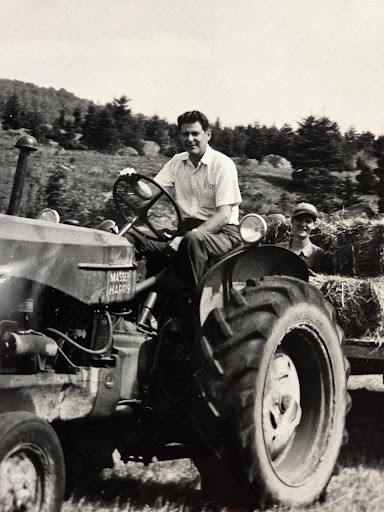
James “Jim” Cassidy at the family farm in Canada. Source: Evelyn Cassidy
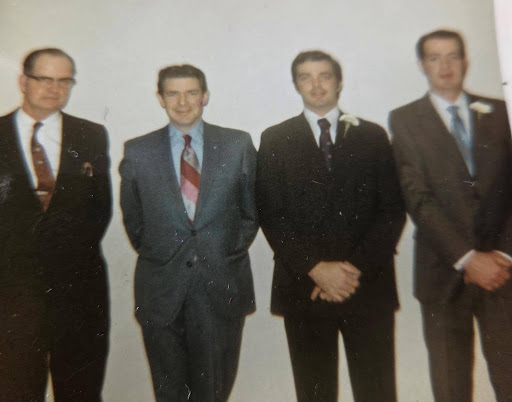
Jim Cassidy (second from left) with his father and brothers. Source: Evelyn Cassidy
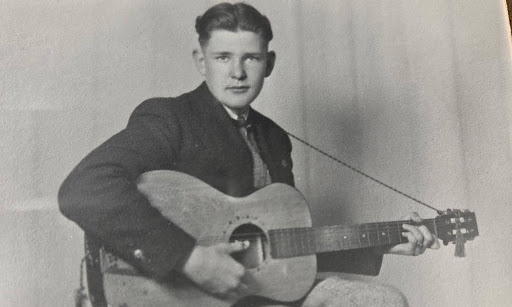
As a young man, Jim played guitar at dances and other gigs across the country to pay for teaching school. Source: Evelyn Cassidy
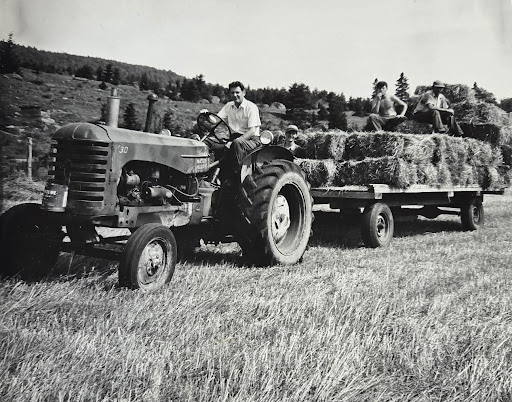
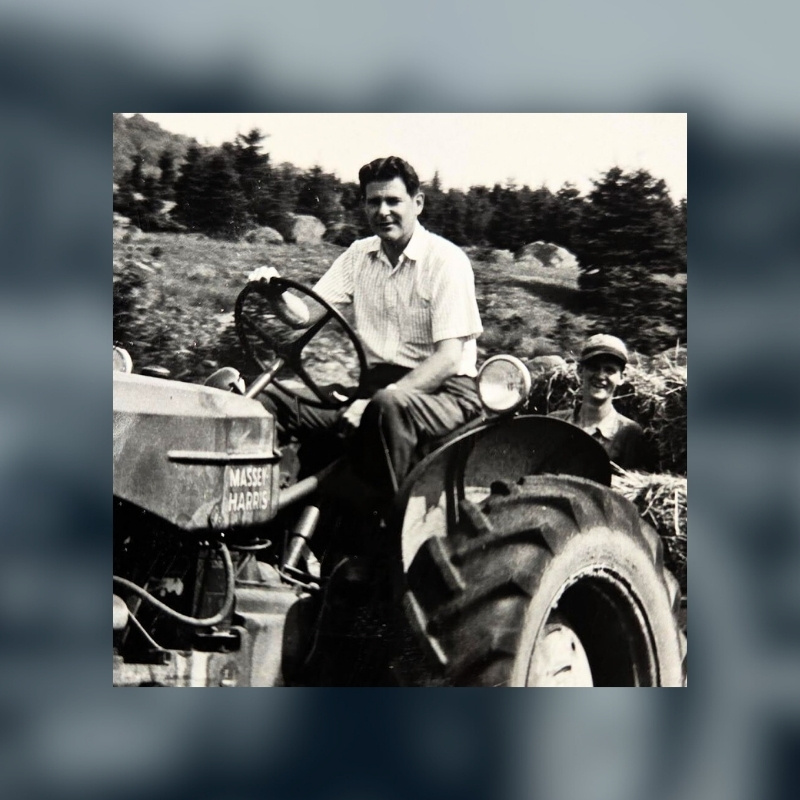
Hauling hay with his family on the family farm. Source: Evelyn Cassidy
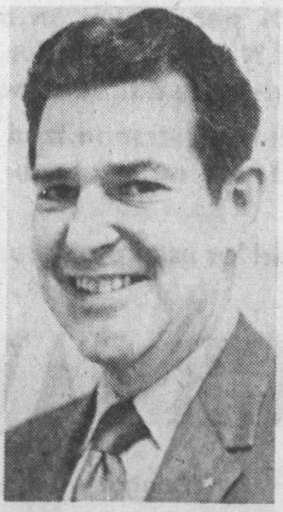
James “Jim” Cassidy. Source: Bangor Daily News
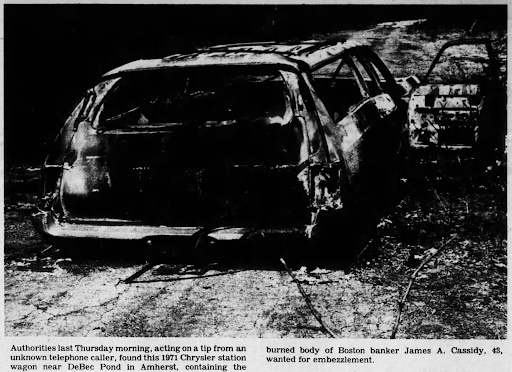
Jim’s burned out car found near DeBec Pond. Source: Ellsworth American
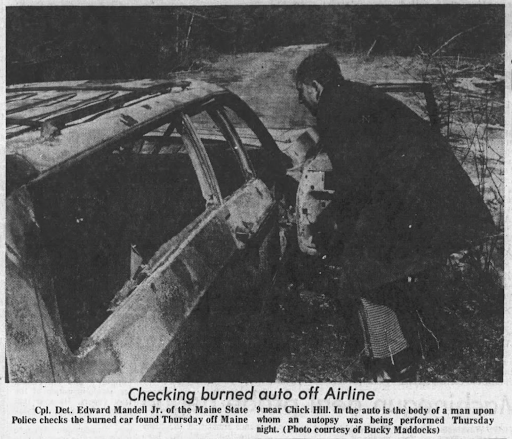
Cpl. Det. Edward Mandell Jr. inspects Jim’s burned-out car. Source: Bangor Daily News
Episode Source Material
- Police Beat: Police fail to find corpse, Bangor Daily News, 8 Apr 1976
- Police seek identity of burned body by Jeff Strout, Bangor Daily News, 9 Apr 1976
- Identity test begun on burned body, Associated Press via Evening Express, 9 Apr 1976
- Burned body found down east believed to be Mass. banker, Associated Press via Kennebec Journal, 9 Apr 1976
- Body is tentatively identified, UPI via The Times Record, 9 Apr 1976
- Burned body may be banker sought in Brookline larceny by Robert J. Anglin, Boston Globe, 9 Apr 1976
- Charred body may be banker sought in Brookline theft by Robert J. Anglin, Boston Globe, 9 Apr 1976
- Body is identified as missing banker by David Bright, Bangor Daily News, 10 Apr 1976
- Crime scene in Aurora, Maine 1976 (YouTube video) by Don Carrigan/WLBZ, archived and digitized by Northeast Historic Film, Apr 1976
- Banker found in car died of burns by Jerry Harkavy, Associated Press via Morning Sentinel, 10 Apr 1976
- Banker sought by FBI found dead, UPI via Morning Union, 10 Apr 1976
- Burned body that of missing banker by Robert J. Anglin, Boston Globe, 10 Apr 1976
- Me. probe continues into banker’s death, Associated Press via Lewiston Daily Sun, 11 Apr 1976
- Maine steps up probe of Mass. banker’s death by Arthur Jones, Boston Globe, 11 Apr 1976
- $1.17m reported lost in Brookline embezzlement by Gary Kayakachoian, Boston Globe, 12 Apr 1976
- Bank official who died in flames ran coin firm by Jeff Strout, Bangor Daily News, 15 Apr 1976
- Fire death of banker may be murder: Cohen, Associated Press via Evening Express, 15 Apr 1976
- Sum in Amherst death seen as “much greater”, Ellsworth American, 15 Apr 1976
- Cohen tends to believe fire death a homicide by Jeff Strout, Bangor Daily News, 16 Apr 1976
- Charred corpse still baffles local police by Jeff Strout, Bangor Daily News, 20 Apr 1976
- Cassidy fire death still a local mystery, Ellsworth American, 22 Apr 1976
- Official denies strangling report by David Bright and Jeff Strout, Bangor Daily News, 23 Apr 1976
- Police still seek answers in Cassidy death by Jeff Strout, Bangor Daily News, 26 Apr 1976
- Cassidy death “suspicious”, but no clues appear, Ellsworth American, 6 May 1976
- Cassidy death probe ‘pointing to homicide’ by Jeff Strout, Bangor Daily News, 5 Jun 1976
- Mass. man witness in Ohio death case by Richard J. Connolly, Boston Globe, 6 Nov 1978
- DeLeo friends sought in ‘76 banker slaying by Richard J. Connolly, Boston Globe, 6 Nov 1978
- Mass. fugitive a key in Ohio murder probe: Two DeLeo friends sought by Richard J. Connolly, Boston Globe, 7 Nov 1978
- Eight deaths since 1974 have been treated as homicides by Pat Flagg, Ellsworth American, 1 Jul 1982
- Closure? by Jesse Ellison, Down East Magazine
- Episode 284: Into the Vault, Criminal Podcast, 13 Sep 2024
- UST plans acquisition, Boston Globe, 2 Apr 1976
- Pine Tree Coin Club plans show, Bangor Daily News, 2 Apr 1976
- Robbery reward offered, Bangor Daily News, 22 Apr 1976
- Belle Island arson, Kennebec Journal, 11 Nov 1976
- 4 held in brawl, shooting, police assault outside Revere cafe, Boston Traveler, 13 Feb 1962
- Artist-Author Emily Carr honored by Canada by Lloyd G. Williams, The Morning Union, 31 Jan 1971
- Informer credited with indicting 26, Boston Record American, 28 Jul 1971
- Newton man, ex-official of Hub bank, shot to death by Robert L. Ward, Boston Globe, 17 Dec 1973
- Diary people quizzed in Hub slaying, Boston Globe, 18 Dec 1973
- 700 attend funeral rites for Morse, Boston Globe, 18 Dec 1973
- Police seek ‘pro’ in banker slaying by Robert L. Ward, Boston Globe, 4 Jan 1974
- Prisoners learn skills in state hospital work by Bruce McCabe, Boston Globe, 21 May 1974
- Norfolk inmates ‘graduate’, Boston Herald, 9 Aug 1974
- After a year, banker’s murder still a puzzle by Richard Connolly, Boston Globe, 19 Dec 1974
- “Model jail prisoner” missing for six weeks, The Recorder, 15 Aug 1975
- Thieves may have netted $3 million, Associated Press via Athol Daily News, 12 Nov 1975
- Police capture jail escapee, The Recorder, 3 Jan 1976
- Victim clings to ring, cops cling to suspects, The Daily Item, 13 Apr 1976
- Robbery suspect arrested, The Daily Item, 5 May 1976
- Two men get 25-40 years in Revere robbery, kidnap, The Daily Item, 3 Jul 1976
- Photo: Anthony Chiodi, The Morning Union, 24 Oct 1976
- SAD 44 may be included in network of community councils by John G. Ferland, Rumford Falls Times, 30 Dec 1976
- COMMONWEALTH vs. FRANK GOLDMAN. (and three companion cases [Note 1]). 5 Mass. App. Ct. 635, September 15, 1977 – October 6, 1977, Suffolk County
- Commonwealth vs. Frank Goldman, 12 Mass. App. Ct. 699, October 14, 1981 – December 3, 1981, Suffolk County
- Obituary: John B. Head, Chandler Funeral Homes and Cremation Service, 25 Mar 2008
- Randolph man pleads guilty to racketeering charge, FBI Boston Division, U.S. Attorney’s Office: District of Massachusetts, 30 May 2012
- Fatal Battleground Avenue collision kills Fumiko Head on January 6, 2025, Rosensteel Fleishman, 10 Jan 2025
- Woman, 87, dies after wreck on Battleground Avenue by Susie C. Spear, News and Record, 11 Jan 2025
- Judge weighing detention of Boston mobster accused of plotting to kill federal officials by Charlie McKenna, The Republican, 27 Jun 2025
- Former mafia ‘street boss’ allegedly plotted to kill feds, prosecutors say by Aaron Katersky, ABC News, 22 May 2025
- Former Mafia ‘street boss’ arrested for allegedly violating probation by Shelley Murphy, Boston Globe, 15 May 2025
- Most wanted refuses to appear, Associated Press via Athol Daily News, 17 Sep 1982